Sloping Sites and Retaining Walls: Why Early Landscape Design Matters
Updated: Feb 21

Sloping sites tend to get labelled as complicated early in a project. In reality, they just require a different starting point. The landscape isn’t something that gets layered on afterwards it becomes part of how the architecture sits within the ground.
Most of the issues that arise later usually come back to level relationships not being fully resolved at the beginning. Once those relationships are clear, many of the design decisions become more intuitive.
Starting with levels, understanding how the finished floor connects to the existing ground is where the work really begins.
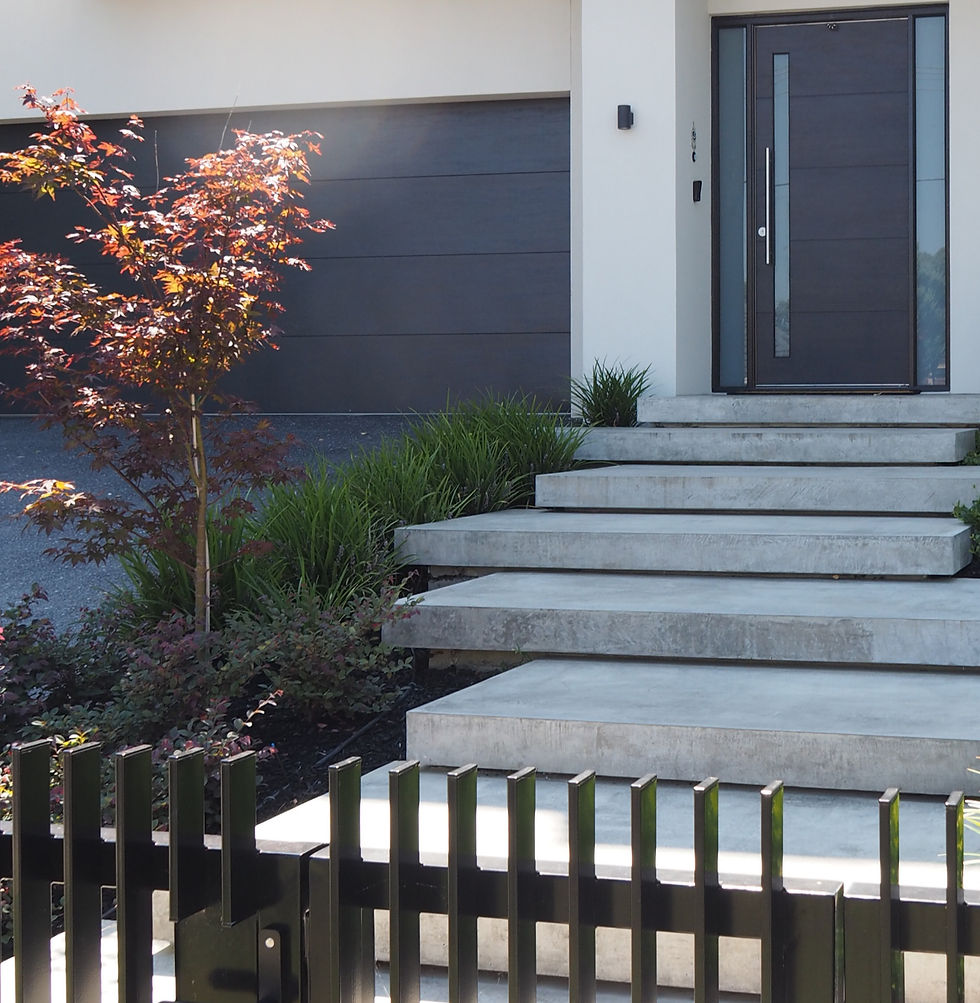
Entry thresholds, external circulation, retaining interfaces, driveway gradients all of these relationships start shaping the spatial structure long before materials or planting are considered. When the levels feel resolved, the rest of the landscape tends to follow naturally. When they don’t, projects often become reactive, adjusting piece by piece rather than developing as a cohesive whole.
Working with the ground rather than against it, every site asks for something slightly different. Sometimes the design moves into the slope, sometimes it builds outward, and often it becomes a combination of both. Terracing isn’t necessarily a stylistic choice it simply emerges as a way of organising space and making level change feel deliberate rather than forced.
Transitions between levels are usually where the project finds its character. Movement becomes more noticeable on sloping sites. Stairs, landings and changes in elevation begin to guide how the space is experienced. When circulation feels intuitive, the slope reads as intentional. When it doesn’t, the landscape can feel awkward or unresolved.
Retaining as part of the architecture, retaining structures inevitably play a strong role, but they rarely need to feel purely functional. They define edges, establish hierarchy and often become the framework that holds the design together. Breaking retaining into smaller layers or shifts tends to create a more balanced outcome than relying on singular large elements.
Planting tends to work best when it reinforces the structure already established through levels. Layering, grouping and allowing the planting to follow the form of the landscape usually creates a more grounded result. Over time, this also tends to age better as the garden settles into the slope rather than sitting on top of it.
Construction considerations inevitably influence the design. Access, sequencing and how elements are actually built become more present in the process. Addressing these early generally leads to cleaner detailing and fewer compromises during delivery.
Level change introduces a certain rhythm into a project. Views reveal themselves gradually. Spaces feel connected through movement rather than boundaries. The landscape unfolds as you move through it.
Handled well, the slope stops feeling like a constraint and simply becomes part of the site’s identity.


Comments